
Yes. Spira learns from your documentation style, note preferences, and prior treatment patterns to tailor its suggestions to how you actually practice — not a one-size-fits-all template.
ABOUT SPIRA
Built for how you actually practice.
Purpose-built for radiation oncology. Every model, every workflow, every recommendation — designed around the way oncologists think and chart.
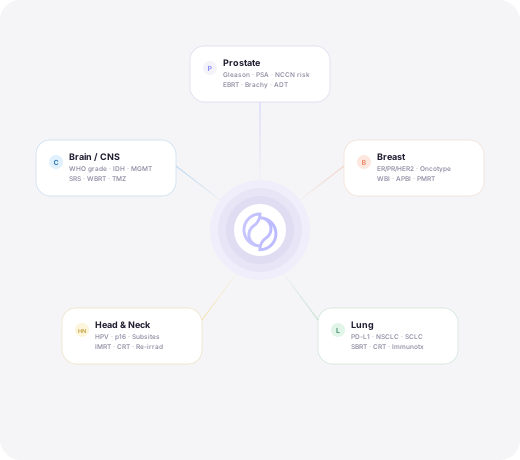
Disease-site specific intelligence.
Not a general-purpose AI adapted for oncology. Spira’s models are built from the ground up for each cancer type — understanding staging systems, fractionation schemes, and treatment protocols the way you do.
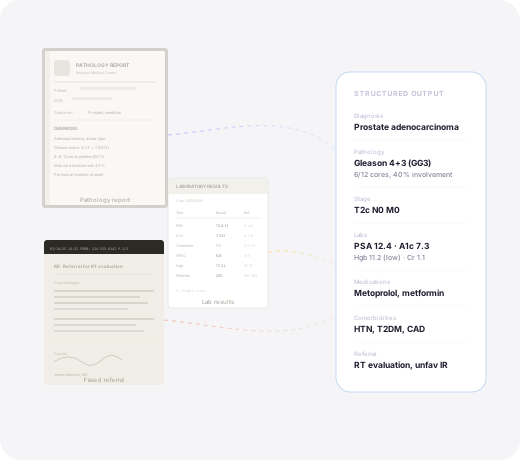
Reads any document. Any format.
Scanned PDFs, faxed records, outside facility notes, handwritten referrals — Spira processes them all. Hundreds of documents structured and indexed automatically.
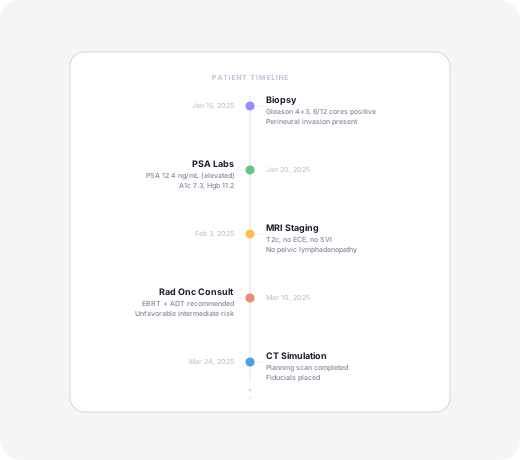
The full picture. One timeline.
Every document organized chronologically — biopsies, scans, consults, labs. Scroll through months of clinical history in seconds instead of clicking through dozens of charts.
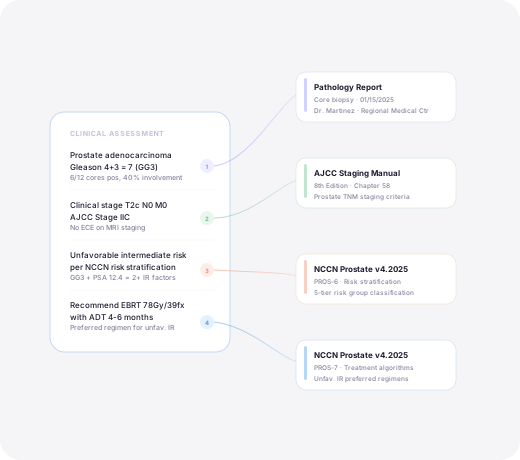
Every answer traced to its source.
No black box. Every staging decision, risk assessment, and treatment recommendation links directly to the guideline or patient document it came from.
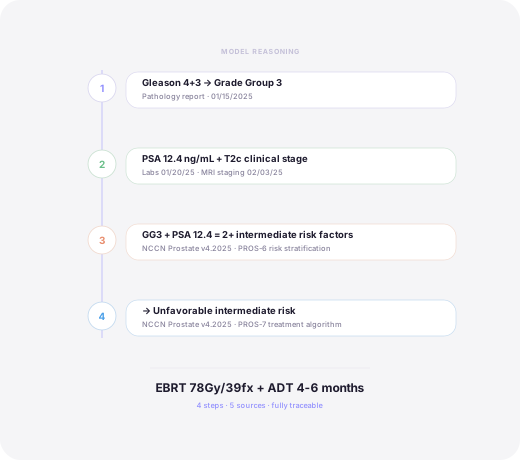
See the reasoning. Not just the answer.
Spira shows exactly how it arrived at every conclusion — step by step, source by source. The full reasoning chain, so you can verify the logic as fast as you can read it.
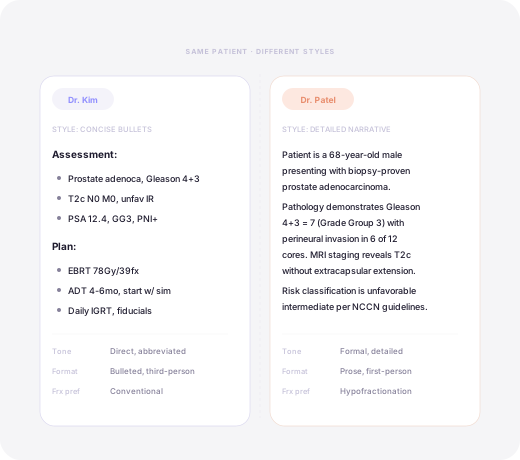
Adapts to how you practice.
Spira learns your documentation style, note preferences, and treatment patterns. Two physicians in the same department get completely different outputs — each one sounds like them.
FAQ
What disease sites are supported?
We currently support prostate, breast, lung, and CNS. Additional sites are actively in development.
Where is my patient data stored?
All data is stored on industry-leading, HIPAA-compliant cloud infrastructure with encryption at rest and in transit. Built to meet the security standards your institution expects — no shortcuts.
Do you train AI models on my patient data?
No. Your patient data is never used to train or fine-tune any AI model. Spira works by referencing your clinical context in real time to generate relevant suggestions — your data informs your session, then stays yours. It is never incorporated into model weights or shared across institutions.
How is security and compliance maintained?
We maintain enterprise-grade security with full HIPAA compliance and active monitoring through industry-leading security platforms. Real-time transparency into our security status is available, and all data is encrypted both in transit and at rest. See our security report for more information.
How is Spira different from other AI charting software?
Unlike generic healthcare AI tools, Spira is built disease-site by disease-site specifically for radiation oncology. We’re founded by clinically trained medical physicists and radiation oncologists who understand oncology workflows, and our platform integrates clinical evidence rather than just summarizing existing notes.
Which EHR systems does Spira integrate with?
Spira is designed to integrate seamlessly with all major EHR systems. Our platform works within your existing workflow without requiring changes to your current documentation process.
Does this work with other medical specialties?
Currently, Spira is only supporting radiation oncology. We believe specialization is key to delivering the precision and accuracy that physicians need, rather than trying to be a one-size-fits-all solution.
GET STARTED
Spend less time charting.
More time with patients.
See how Spira integrates into your existing EHR and delivers evidence-based charting in a live demo.

HIPAA Compliant

Enterprise Security